

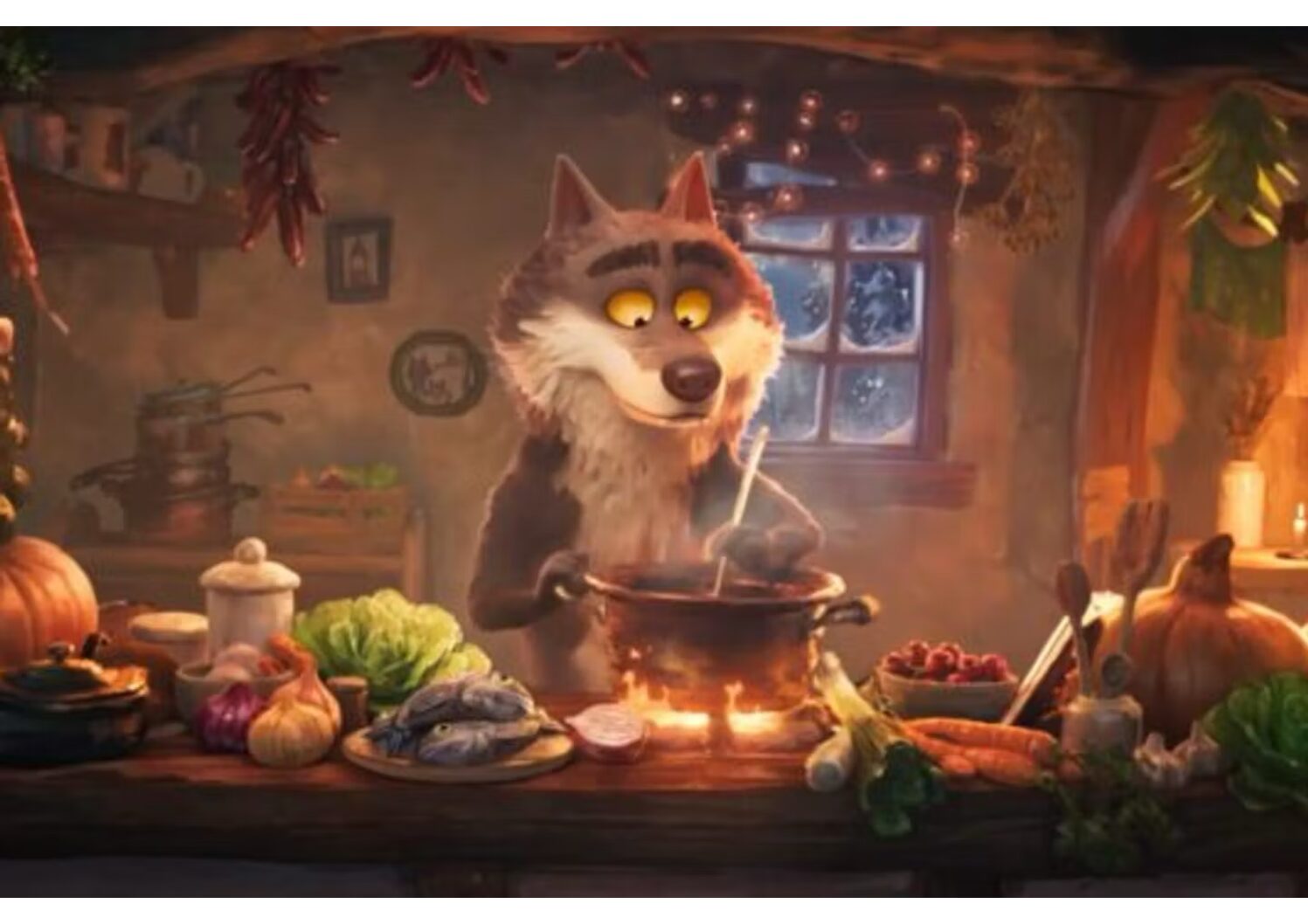
Everyone has talked about Intermarché’s wolf. It’s true that the spot is splendid, which is rare enough to deserve applause. People have also reacted to the production method, highlighting the studio’s prowess in motion design, some not hesitating to present it as a comeback of the old artisanal know-how against the bulky AI.
That’s a reductive, anecdotal angle of analysis… It doesn’t matter the method, only the result counts, right? What I want to highlight here is above all the creative quality of the spot. If the core idea itself isn’t original, the storytelling is very well executed and fits perfectly with the brand’s universe and the season’s mood.
While most advertisers, once again, content themselves with glorifying their product offers (oh, how beautiful my cake is, oh, how cheap my oysters are), Intermarché makes the effort to contribute to the magic of Christmas by sharing a beautiful story. He’s not the only one doing it, but let’s admit that those who do it are a minority. And it’s not just a budget issue—indeed AI solves that problem—it’s really a question of what advertising should be.
There are two schools contesting our profession: The first holds that media amplification comes first, that any message will impose itself if it is repeated long enough. If you have nothing to say, say it loud. The second, by contrast, holds that creation comes first, that a seductive, convincing, impactful message will reduce the media effort through the interest it generates.
Common sense should guide all professionals, advertisers and agencies alike, toward the second solution, because it enriches the world more, especially because media spend is expensive and if a quality message can divide the GRP costs, it practically offers a significant economic advantage. Alas! It’s easier to buy space than to judge creations. It must be said that for thirty years the first school has triumphed over the second. It should also be noted that image banks, budget tightening helping, have contributed to cement its victory, by turning too many creatives into the laborious commentators of photos.
The example of this wolf, regardless of its making-of, is a fine demonstration of the vitality of the new creative generation. I see it—as a senior advertising executive—a glimmer of hope for our profession, and incidentally for advertisers’ KPIs. If, with the help of computing, including AI (the most incredible palette there is), more agencies return to fighting for ideas, if the second school regains breath, I am convinced that not only will our screens, our billboards, our pages, and our earphones perform better, but our collaborations will be more satisfying.
We need to bring back more creative ambition at the heart of advertising, for it is the best remedy for procedural frustration.
Here’s a demanding ambition! A quality creation isn’t just anything that stands out. For it to perform, it must be fair, engaging, and attributable. How many spots have we seen that told an original story with no link to the brand? How many times have we asked what that opaque slogan or that absurd vignette meant?
Perhaps tomorrow, advertisers who are both cooled by the cost of media and warmed by the accessibility of offbeat ideas will be more willing to buy grains of madness (go check out Thailand—frankly, there is room for it here too), provided the creatives who cultivate them are up to the task. And that’s rarely the case. Talent, you know, doesn’t happen on the spur of the moment. Taking a side step isn’t taking a step forward. A good creation is a transcended strategy, not a neglected one. It’s a brilliantly composed symphony, not a narcissistically justified improvisation.
To see the coming years mark the return of the son of creative vengeance, we’ll need to find Jedis again and re-train Padawans. Worse: we’ll have to pay them properly again. Well, since production costs nothing anymore… It’ll work.
With that note of optimism, I wish you happy holidays. And may you have wonderful ambitions for what lies ahead