

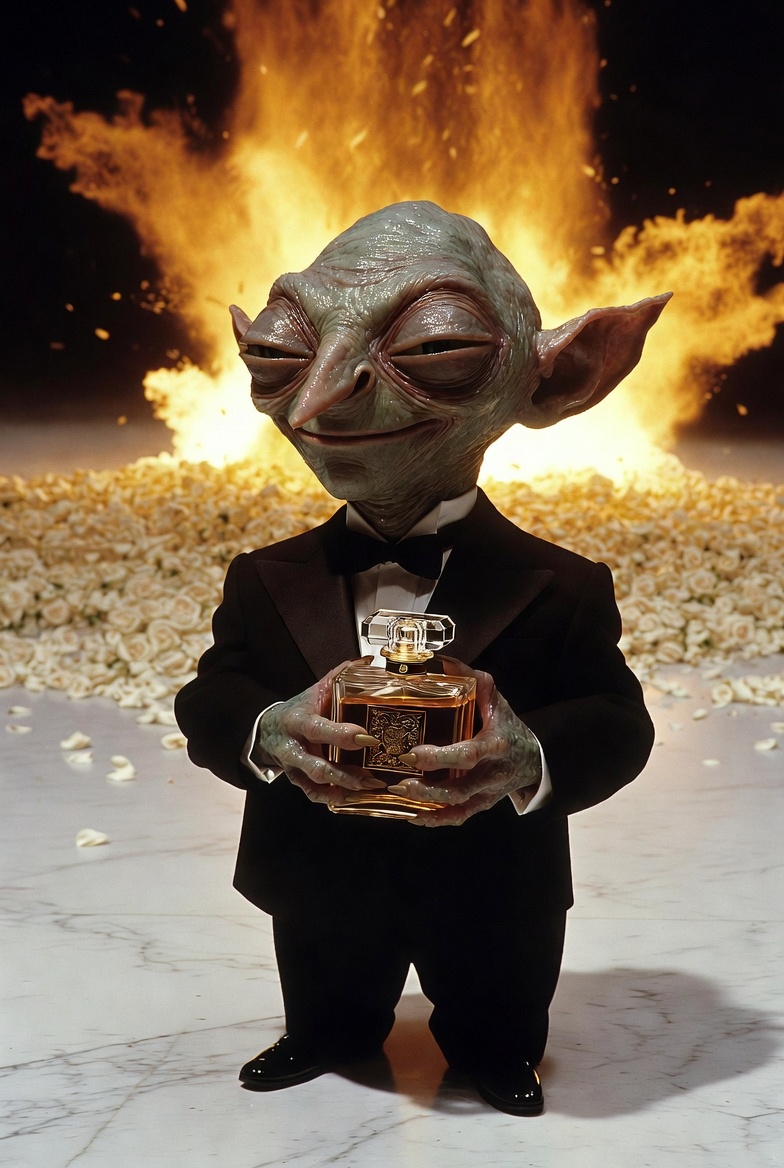
In 2026, you can shoot an entire beauty campaign without a single model stepping into a studio.
“Are we going to replace humans?”
That’s a bad question.
The right question: what stories are we now able to tell that we couldn’t tell before?
Because AI used to “do the same, cheaper” is the most boring AI in the world. The one that compresses human complexity into stock imagery. In advertising, we need the exact opposite: more nuances, more narratives, more singularity.
AI becomes powerful when it opens the field. For example, for cosmetics:
→ Imagine characters we would never have dared to cast.
→ Explore bodies, ages, skin tones, hybrid universes.
→ Visualize the invisible (action mechanisms, metamorphoses, projection through time)
And of course: test the creative territory to optimize it.
A virtual model makes sense if it creates something new : narratives that are more inclusive or more radical than we prototype before entrusting them to real talents. Symbolic figures (avatar-manifests, archetypes, routine guides) that enrich a universe without claiming to be “real people.” A protection for real people when exposure is too violent.
But as soon as it’s just used to replace a human face with a “clean” avatar to save time, it creates nothing. It destroys value.
We can never say this enough: the issue is not “AI vs humans”, it’s the creative pipeline!
– AI as a workshop: experimentation, prototyping, visualization.
– Humans as the heart: emotion, proof, truth of the promise.
With a non-negotiable ethical line: transparency about what is generated, no fake before/after on fictional faces, no emotional deepfake, no algorithms that “forget” certain phototypes.
When these foundations are in place, AI is no longer a threat to talent. It becomes a creative toolbox that pushes teams to go further, then to return to reality with a stronger angle.
#AI #Beauty #Creativity #AICreativity #BeautyMarketing #VirtualModels #BrandStrategy #Ethics #AIinMarketing