

Summer World Tour: From Tokyo to São Paulo, Advertising Goes Far Off the Beaten Path
While Europe takes a break, the rest of the world experiments. This month, three stops worth a detour: a fictitious Mercedes factory that has Tokyo buzzing, weather-sensitive screens in Manila, and Brazil diving into programmatic DOOH. Spoiler: it makes you want to travel.
Tokyo: Mercedes installs a (fake) factory in the heart of the city
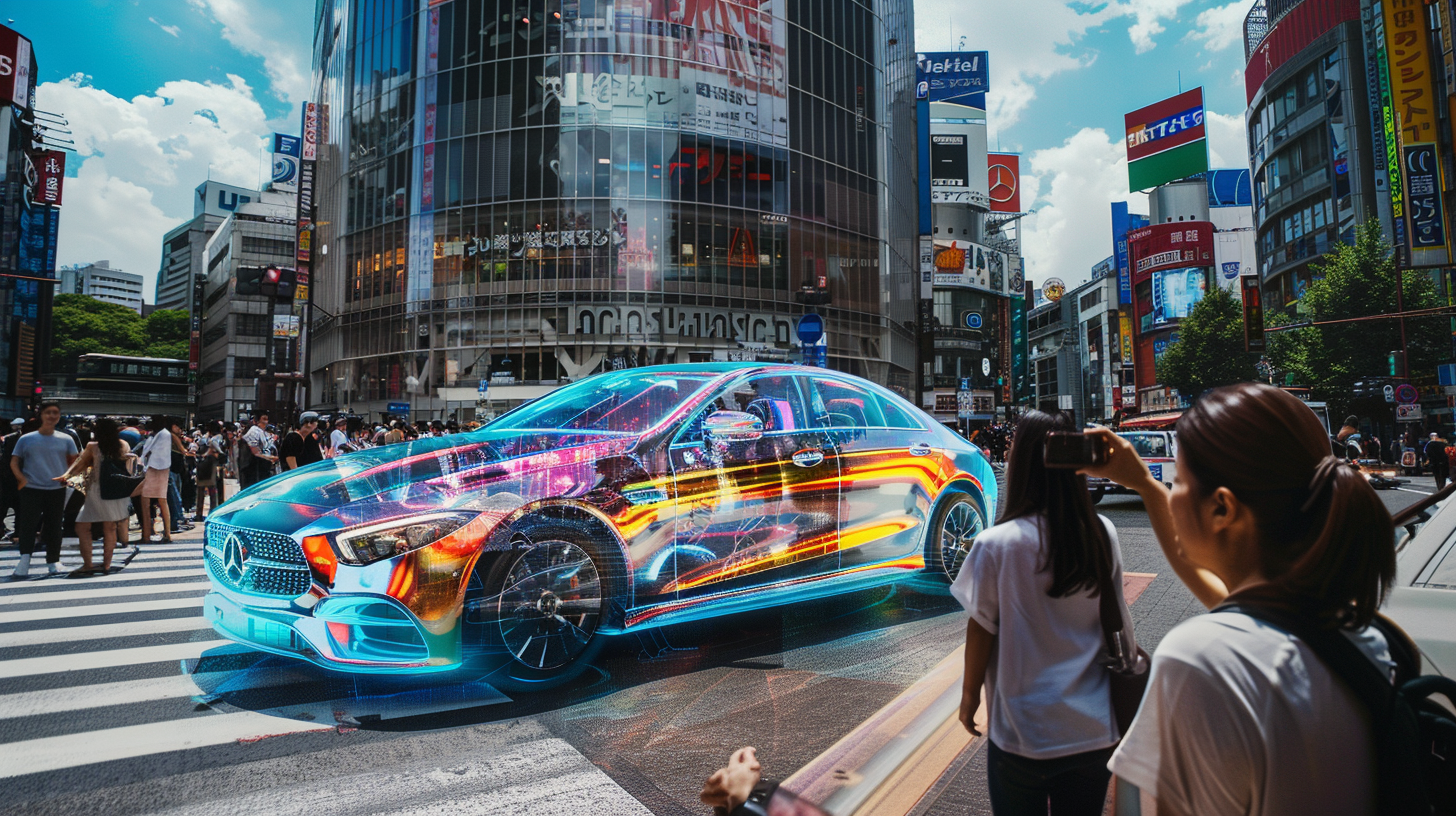
Mercedes-AMG stirred up the streets of Tokyo with a PR stunt particularly well crafted. The idea? To make people believe that a Manufaktur plant had set up in the heart of the city, with a giant robotic arm customizing SLs in all colors in the middle of the street.
The clever trick: Instead of simply placing a 3D car on a building, Mercedes built a real narrative. The virtual factory produces, paints, delivers — all turned into a futuristic urban spectacle. Passersby stop, film, share.
Results: 44 million views. Not bad for a factory that doesn’t exist.
What stands out is the coherence. Mercedes isn’t doing FOOH to impress, but to anchor its message of hyper-personalization in something tangible. A lesson for anyone who still believes you only need to stick 3D onto a screen to generate buzz.
Useful links :
️ Manila: Sunsilk reads the weather
In the Philippines, Sunsilk had a simple but devilishly effective idea: connect its advertising screens to the weather. The result: in Manila, every digital panel adapts in real time to weather conditions.
How it works: Rain? The screen suggests the anti-frizz shampoo. Scorching sun? Focus on hair protection. Tropical humidity? A smoothing product. Each weather change becomes an advertising opportunity.
The numbers that please: +203% in impressions and +289% in unique reach versus a standard DOOH campaign. Contextual relevance really pays off.
The Sunsilk trick? Exploit a local specificity—the Philippines’ changing tropical climate—to create an advertising experience that perfectly matches the daily concerns of women consumers. Clever.
Useful links :
São Paulo: InfinitePay tests next-generation DOOH
Brazil is crossing a milestone in out-of-home advertising. In 2025, JCDecaux and VIOOH launched their programmatic DOOH offering, and InfinitePay, a Brazilian fintech, served as the test case for the first campaign.
The concept: No more fixed-space buying. Here, everything is negotiated in real time like web display. InfinitePay was able to target its audiences with surgical precision across all premium screens in São Paulo, with instant optimization and immediate impact measurement.
Why it’s interesting: This experiment blends data, AI and local creativity in a totally new approach to outdoor media. Brazilian DOOH shows that you can now do programmatic in the street with the same sophistication as on the web.
The Peruvian bonus: In Madrid, the “Perú Wow” campaign also drew attention by combining DOOH, digital influence and creative storytelling (astronauts dazzled by the country) to attract international travelers. Latin America clearly knows how to do it.
Useful links :
- JCDecaux VIOOH programmatic DOOH
- InfinitePay digital marketing Brazil
- Peru tourism digital campaigns
Three takeaways
This mini world tour reveals three approaches that work: Tokyo bets on immersive storytelling, Manila leverages the local context, and São Paulo experiments with new programmable formats.
What emerges? The best campaigns no longer copy recipes from elsewhere; they invent tailor-made solutions for their market. Mercedes’ spectacular FOOH, Sunsilk’s weather-sensitive DOOH, InfinitePay’s urban programmatic — each in its own context, each with its own codes.
✨ This week’s idea to steal
Look around you: what local specificity could you exploit to make your campaigns more relevant? Weather, cultural events, consumer habits… There is surely a contextual angle waiting for you.
Like Sunsilk: a well-chosen variable can transform your performance.
Newsletter Pub & Pixels — Your weekly AI marketing briefing
Jean-Marc Segati
Nextage.ai